
Quick Contact
[rt_cf7_style submit_background_color=”#f5f6f6″ submit_hover_color=”#001139″ submit_text_color=”#001a57″ submit_text_hover_color=”#ffffff” radiant_font_color=”#717171″ radius_top=”” radius_right=”” radius_bottom=”” radius_left=”” padding_right=”10px” padding_left=”10px” radiant_border_style=”solid” radiant_border_color=”#e6e6e6″ radiant_border_top=”1px” radiant_border_right=”1px” radiant_border_bottom=”1px” radiant_border_left=”1px” radiant_font_focus_color=”#00174d” radiant_background_focus_color=”#efefef” radiant_focus_style=”solid” radiant_focus_color=”#e6e6e6″ radiant_focus_top=”1px” radiant_focus_right=”1px” radiant_focus_bottom=”1px” radiant_focus_left=”1px” radiant_extra_class=”service-form” cf7_content_css=”.vc_custom_1519126255771{margin-right: 0px !important;margin-left: 0px !important;padding-right: 0px !important;padding-left: 0px !important;}”]Need Help?
Please Feel Free To Contact Us. We Will Get Back To You With 1-2 Business Days.
info@example.com
(888) 123-4567
Download
Company White Paper
1.30 MB
Company Media Kit
1.22 MB
Phosphating Process 7 Tank Process for Powder Coating
The 7 Tank Process for powder coating on metal is composed of the following steps: Degrease Rinse Pickling Rinse Phosphating Rinse and Passivation In some cases, we use Activator before Phosphating Also known as the zinc phosphating process. M. Chem. Chemicals provide a wide range of Pretreatment Chemicals for the 7-tank process of powder coating on metal.
Mahavir Chemicals offers best quality M. Chem series of chemicals for 7 Tank Phosphating
Pretreatment for Powder Coating. With our extensive experience in manufacturing, we have made reputed name in the market. Our 7 Tank Phosphating Process Chemicals are safe and Biodegradable.
Our 7 Tank Process chemicals are ready to use for any Metal surface Pre-Treatment. Over and above that we provide free consultation in setting up of the 7 Tank Process Plant.
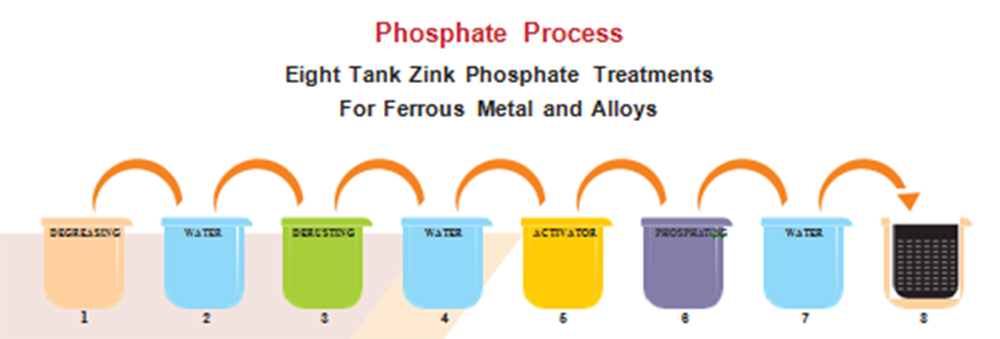
Procedure for Seven Tank Phosphating in Powder Coating on Metal
The procedures that we must adhere to for the Seven Tank Process of Powder Coating Metal are as follows:
1)Degreasing in 7 Tank
The 7 Tank Process for powder coating on metal requires the removal of oil, grease, and soil. To do this, we provide M.CHEM .D.G. Series of both alkaline and acidic degreasers, which are usually used in hot conditions. Acidic degreasers are acidic liquids that work best in cold conditions, but are more expensive than alkaline degreasers
Solution Strength:The solution strength of the degreaser would be 5-7 kg per 100l of soft water.
Duration: The duration of the process is 20-40 minutes
Temp.: It works best in high temperatures of 75-80 degrees Celsius.
2)Rinsing
Rinse with water in the second tank of the seven-tank process after degreasing. The purpose of the water wash is to eliminate the degreasing effect from the metal surface. It stops chemicals from going through other steps. Make sure it has been well rinsed before moving on to the next step.
3)Derusting in Seven Tank
After washing the metal surface with water, proceed to de-rusting. Submerge the object in the de-rusting chemical solution-filled third tank of the seven-tank powder coating process. To do this, make use of pickling and acidic de-rusting chemicals to remove oxide layers, rust, and scale from all surfaces. The most effective de-rusting solution is provided by the M. Chem R.R. series of chemicals.
Solution Strength: To make the rust remover solution workable from ambient temperature to a maximum of 60 degrees Celsius, mix 25 litres of the remover with 75 litres of soft water.
To make the rust remover solution workable between 45 and 60 degrees Celsius, mix 10 to 12 litres of the remover with 90 litres of soft water.
Duration: 15- 20 minutes
Temp.: Ambient temp to max 60 C
4)Rinsing
Rinse with water once again in the fourth tank of the powder coating process’ seven tanks.The fourth water wash tank eliminates the chemical de-rusting agent’s effect on metal surfaces. Because the de-rusting chemicals are acidic by nature, this prevents them from working any further. Thus, ensure that a thorough water rinse has taken place before proceeding to tank 5.
Maintain PH of water to 7 PH Scale.
5)Surface Activation in 7 Tank Process
Next step in 7 Tank Process for Powder Coating is Surface Activation. This step is optional. Surface activation chemicals activate the metal to get a fine crystalline structure during phosphate coating. This will increase corrosion resistance and adhesion properties. Generally, a crystalline structure of under 10 microns is recommendable. Mahavir Chemicals offers M. Chem. S.M. Series for Activator. Acidic, as well as new Alkaline Activator compounds, produce a compact crystal structure of phosphate coating.
Strength: PH and Alkalinity are to be maintained.
Duration: 20 minutes
Temp.: This works at Room Temperature.
6) Phosphating in 7 Tank Process
Phosphating Process is the most important process of 7 Tank Process for Powder Coating. In general, we call 7 Tank Process as Phosphating Process. For Phosphating to Metal, we prepare Zinc Phosphate Solution using M. Chem. L. P. Series of chemical for Phosphating. Zinc Phosphate solution makes the coating of sheet metal surface smooth and uniform. Zinc Phosphate Coating is grey in nature. M. Chem. L. P. Series of chemical for Phosphating gives the best result in 7 Tank Phosphating Process.
Strength: Fill the tank with 2/3 rd of its capacity with soft water. Add M. Chem L.P. Series of chemicals for bath solution of 1000 liters. Raise the bath temperature to minimum 50-60 C. Add toner crystals. Top up Tank with soft water and raise the temperature.
Duration: 5-20 minutes. Time may vary depending upon the temperature of bath and thickness of powder coating required.
Temp.: It works at 50-60 C.
7)Passivation in 7 Tank Process
Now, the last step in the 7 Tank Process for Powder Coating is to Passivate the Metal. The passivation forms a layer of chrome over the zinc phosphate. It increases the corrosion resistance protection of the metal parts. It seals the pores of sheet metal surfaces to obtain maximum corrosion resistance over phosphate coating.
Strength: Again, Fill the tank with two-thirds of its capacity with soft water. For Passivation, Add M. Chem Passi. Series of chemicals for bath solution of 1000 liters. Raise the bath temperature. Top up the Tank with soft water.
Duration: Time may vary depending on the temperature of the bath.
Temp.:75+/- 5 C. It works both in High and Low temperatures.
4)Rinsing
Rinse with water once again in the fourth tank of the powder coating process’ seven tanks.The fourth water wash tank eliminates the chemical de-rusting agent’s effect on metal surfaces. Because the de-rusting chemicals are acidic by nature, this prevents them from working any further. Thus, ensure that a thorough water rinse has taken place before proceeding to tank 5.
Maintain PH of water to 7 PH Scale.
5)Surface Activation in 7 Tank Process
Next step in 7 Tank Process for Powder Coating is Surface Activation. This step is optional. Surface activation chemicals activate the metal to get a fine crystalline structure during phosphate coating. This will increase corrosion resistance and adhesion properties. Generally, a crystalline structure of under 10 microns is recommendable. Mahavir Chemicals offers M. Chem. S.M. Series for Activator. Acidic, as well as new Alkaline Activator compounds, produce a compact crystal structure of phosphate coating.
Strength: PH and Alkalinity are to be maintained.
Duration: 20 minutes
Temp.: This works at Room Temperature.
6) Phosphating in 7 Tank Process
Phosphating Process is the most important process of 7 Tank Process for Powder Coating. In general, we call 7 Tank Process as Phosphating Process. For Phosphating to Metal, we prepare Zinc Phosphate Solution using M. Chem. L. P. Series of chemical for Phosphating. Zinc Phosphate solution makes the coating of sheet metal surface smooth and uniform. Zinc Phosphate Coating is grey in nature. M. Chem. L. P. Series of chemical for Phosphating gives the best result in 7 Tank Phosphating Process.
Strength: Fill the tank with 2/3 rd of its capacity with soft water. Add M. Chem L.P. Series of chemicals for bath solution of 1000 liters. Raise the bath temperature to minimum 50-60 C. Add toner crystals. Top up Tank with soft water and raise the temperature.
Duration: 5-20 minutes. Time may vary depending upon the temperature of bath and thickness of powder coating required.
Temp.: It works at 50-60 C.
7)Passivation in 7 Tank Process
Now, the last step in the 7 Tank Process for Powder Coating is to Passivate the Metal. The passivation forms a layer of chrome over the zinc phosphate. It increases the corrosion resistance protection of the metal parts. It seals the pores of sheet metal surfaces to obtain maximum corrosion resistance over phosphate coating.
Strength: Again, Fill the tank with two-thirds of its capacity with soft water. For Passivation, Add M. Chem Passi. Series of chemicals for bath solution of 1000 liters. Raise the bath temperature. Top up the Tank with soft water.
Duration: Time may vary depending on the temperature of the bath.
Temp.:75+/- 5 C. It works both in High and Low temperatures.
Frequently Asked Question
[rt_accordion_style radiant_accordionstyle=”three” radiant_extra_class=”accordion-style-three”][rt_accordion_style_item radiant_accordiontitle=”Where can I get 7 Tank Phosphating Process Chemical?”]Mahavir Chemicals are the leading manufacturer of 7 tank process chemicals in Mumbai, India. With our expertise and trustworthiness, we emerged as a foremost supplier of pretreatment Chemicals. We offer wide range of best quality 7 Tank Process Chemicals.[/rt_accordion_style_item][rt_accordion_style_item radiant_accordiontitle=”Why do I need a Degreaser ?”]The answer depends on the application. Dust, dirt, grease, and oxidation contamination can cause corrosion, slipping hazards, overheating, increase electrical resistance in contact areas, and many other issues. Degreasing may be required to prep for downstream processes like painting or plating.Cleaner Degreasers can clean oil, grease, oxides and handling contamination, from equipment and assemblies
Industrial strength degreasers are needed to remove grease, tar, asphalt, oil, and grime[/rt_accordion_style_item][rt_accordion_style_item radiant_accordiontitle=”What are the cleaning process to consider for Degreasing ?”]Manual Degreasing Methods
It is common to clean grease and oil off of parts at a benchtop, work station, or in the field, which generally requires a manual cleaning method. Manual cleaning methods are more labor-intensive and less repeatable, so results may vary from operator to operator.
-
Aerosol –
-
Trigger spray
-
Liquid immersion
-
Presaturated wipes and swabs
[/rt_accordion_style_item][rt_accordion_style_item radiant_accordiontitle=”Does a degreaser need to be nonflammable?”]Nonflammable degreasers are the safest options if they will be used near sparks, open flames, or hot surfaces.
[/rt_accordion_style_item][rt_accordion_style_item radiant_accordiontitle=”Do I need to shut off power before cleaning electrical equipment?”]Before you start spraying, shut down power to avoid the potential of sparks, electrical shorts or discharges, and other safety hazards. If disconnecting the power is not an option, look for degreasers with a dielectric strength above 30 kV (30,000 volts). Choosing a nonflammable cleaner would also add a layer of safety in case there is a spark.[/rt_accordion_style_item][/rt_accordion_style]